Is My Artificial Grass Really Cheaper Than Natural Sod Over 10 Years?
Artificial turf often enters the conversation as a promise: less mowing, lower water bills, and a lawn that stays green through heat, drought, and heavy use. Yet the real question for homeowners is not whether it looks tidy on day one, but whether it remains financially sensible over a full decade. This article breaks down installation costs, maintenance needs, lifespan, climate factors, and resale considerations so you can judge the long-term math with clear eyes.
Outline
- How to compare artificial turf and natural sod on equal terms
- Why installation costs usually favor sod at the beginning
- How maintenance, water, and repairs change the ten-year total
- Which comfort, climate, and environmental factors affect value
- When turf is likely to save money and when natural grass still wins
1. Building a Fair 10-Year Comparison
If you want an honest answer to the question in the title, the first step is refusing the easy shortcut. Artificial turf is often marketed as “maintenance free,” while sod is sometimes presented as a money pit that never stops asking for more. Neither picture is accurate. A proper comparison should look at the same lawn size, the same local climate, the same household habits, and the same standard of appearance. A neat front yard maintained by a hired crew is a different financial story from a backyard patch that a homeowner mows with a paid-off mower on Saturday mornings.
A useful way to compare the two is to build a ten-year model around a common residential lawn size, such as 1,000 square feet. That size is large enough to show real cost differences without drifting into estate-scale landscaping. Then layer in the variables that actually move the numbers:
- Installation price per square foot
- Water rates and irrigation demand
- DIY versus professional maintenance
- Climate stress, including drought, shade, and freezing cycles
- Traffic from kids, pets, or entertaining
- Expected lifespan before replacement or major renovation
For many U.S. households, natural sod is far cheaper to install at the start. Artificial turf often narrows the gap later through reduced mowing, fertilizing, and watering. The catch is timing. A homeowner who plans to move in four years may never recover a turf installation bill. Someone staying put for a decade in a dry region with expensive water may see a very different outcome. That is why the same product can feel like a smart long-term upgrade in one zip code and an expensive convenience in another.
There is also a hidden issue that often gets ignored: what standard are you trying to maintain? If your natural lawn goal is “healthy enough, with a few brown spots in late summer,” your costs may stay modest. If your goal is “dense, evenly green, and photo-ready,” sod becomes more demanding. Fertilizer schedules, irrigation tuning, overseeding, aeration, weed control, and occasional patch repair all add up. Turf, by contrast, delivers a more predictable appearance, but it does not eliminate chores entirely. Debris removal, brushing, rinsing, seam checks, and odor management for pet areas still belong in the budget. Once those realities are placed on the same spreadsheet, the ten-year answer becomes much more useful than any sales slogan.
2. Upfront Costs: Why Artificial Turf Usually Starts at a Disadvantage
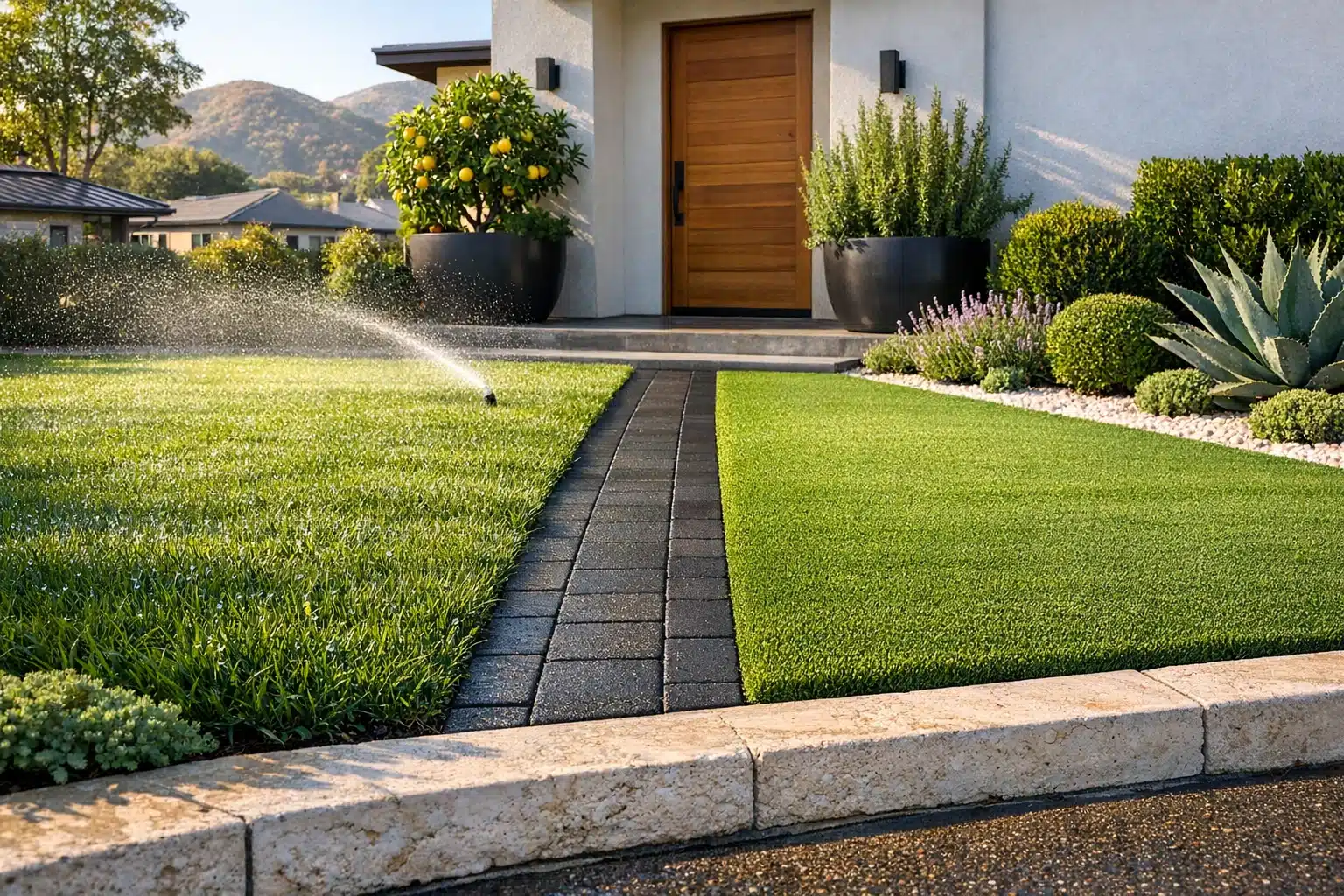
The financial race between turf and sod does not begin at the same starting line. Artificial turf usually asks for a serious investment before the first barbecue, first soccer game, or first summer heat wave. In many residential markets, installed artificial grass commonly falls around $8 to $20 per square foot, with premium systems or difficult sites running higher. For a 1,000-square-foot lawn, that can mean roughly $8,000 to $20,000 or more. By comparison, installed natural sod often lands closer to $1 to $3 per square foot, though local labor, grading, and premium grass varieties can push that upward. Even with soil preparation and delivery included, sod typically remains dramatically cheaper at the outset.
Why is turf so expensive? The visible green surface is only part of the bill. The real cost sits underneath, where proper installation determines whether the lawn looks smooth and drains well or turns into a wrinkled, uneven headache. A standard turf project may include:
- Removal of existing grass, weeds, and roots
- Excavation and hauling away old material
- Installation of a compacted aggregate base
- Grading for drainage
- Edging and seam work
- Infill material and final grooming
Each step adds labor, equipment time, and material cost. Skip those layers, and the cheaper quote may turn into a more expensive repair job later. That is one reason bargain turf bids deserve careful scrutiny. A low price can hide thin base preparation, poor drainage planning, or lower-grade fiber that mats down early. In other words, the bill arrives long before the long-term savings, and it arrives with confidence.
Sod has its own setup costs, but the list is shorter and usually gentler on the wallet. Soil amendment, leveling, starter fertilizer, and irrigation checks may be needed, yet the system itself is biologically simple. The lawn roots into the ground rather than sitting on a constructed base. There can still be extra expenses if you need new sprinklers, topsoil, erosion control, or drainage work, but the entry fee remains much lower in most cases.
That difference shapes the entire ten-year comparison. Imagine a mid-range sod installation at $2,500 and a mid-range turf installation at $12,000 for the same area. Turf starts about $9,500 behind. To justify the premium over ten years, the synthetic lawn must save roughly $950 per year on maintenance, water, and repairs just to break even, without counting financing costs or replacement risk. That does happen for some households, but not nearly as automatically as promotional brochures may imply.
3. Ten Years of Maintenance: Where Turf Has a Real Chance to Catch Up
Once the installation dust settles, the comparison shifts from sticker shock to operating cost. This is where artificial turf makes its strongest case. A natural lawn is a living surface, and living things need ongoing attention. That attention may come in the form of money, time, or both. Over ten years, these recurring expenses can become substantial, especially for homeowners who pay professionals for regular lawn care.
Natural sod commonly brings costs such as:
- Mowing, either with your own equipment or a lawn service
- Watering during dry periods
- Fertilization and weed control
- Aeration and overseeding
- Pest or disease treatment when needed
- Patch repair in worn or shaded areas
If a homeowner mows and does basic care personally, annual costs may stay relatively moderate. If the same lawn is serviced by professionals, the total can rise quickly. Weekly mowing during the growing season alone can add hundreds or even several thousand dollars per year depending on region and service level. Water costs vary just as widely. In areas with low rates and regular rainfall, irrigation may be a minor line item. In drought-prone places with tiered water pricing, summer irrigation can become one of the largest parts of the lawn budget. Over a decade, that difference matters.
Artificial turf usually avoids mowing, fertilizing, and most irrigation, but “no maintenance” is still the wrong phrase. Synthetic lawns generally need leaf and debris removal, occasional rinsing, brushing to keep fibers standing, and minor infill redistribution. Pet owners may also need enzyme cleaners or deodorizing treatments. Some households hire annual or semiannual cleaning services, particularly if the turf sees heavy use. Repairs are less frequent than with natural sod, yet they are not impossible. Seams can loosen, edges can lift, drainage can underperform if the base was compromised, and heavily trafficked zones can flatten over time.
A rough ten-year example for a 1,000-square-foot lawn helps illustrate the pattern. A homeowner-managed sod lawn might average $400 to $1,200 per year when including water, fertilizer, occasional repairs, and equipment upkeep, creating a ten-year range of about $4,000 to $12,000. A fully serviced sod lawn in a dry climate can exceed that. Artificial turf maintenance might average closer to $100 to $500 per year, or about $1,000 to $5,000 across ten years, depending on debris, pets, cleaning habits, and whether professional refresh services are used.
The important nuance is this: turf often wins on annual predictability, not always on total dominance. If your natural lawn is already inexpensive because you do the work yourself and water is cheap, turf may not catch up. If you outsource lawn care, fight dead patches every summer, and pay meaningful water bills, the math can move sharply in turf’s favor.
4. Beyond the Spreadsheet: Lifespan, Comfort, Climate, and Environmental Trade-Offs
Money matters, but homeowners rarely make landscaping choices with a calculator alone. Lawns are lived-in spaces. They host pets, birthday parties, bare feet, muddy shoes, and those quiet five-minute pauses when someone steps outside just to breathe. Because of that, the better option is not always the one with the cleanest spreadsheet. Artificial turf and natural sod offer different experiences, and those differences can affect long-term value in ways a simple cost table cannot fully capture.
Lifespan is one major factor. Residential artificial turf is often expected to last around 8 to 15 years, with better products and lighter use sometimes stretching beyond that. Heavy traffic, intense sun, poor drainage, or low-quality installation can shorten the timeline. Natural sod does not have a fixed replacement date in the same way. It can survive indefinitely with proper care, though it may need renovation, reseeding, or re-sodding in troubled areas. This matters because a turf system that needs replacement at year nine changes the ten-year economics dramatically.
Surface temperature is another practical issue. Artificial grass can become significantly hotter than natural grass in direct sun, especially during peak summer conditions. Depending on the product, weather, and color, the difference can be uncomfortable enough that families avoid walking on it barefoot during hot afternoons. Some products include cooling technologies or are paired with shade strategies, but buyers should not assume a turf yard will feel like living grass underfoot. Natural sod generally stays cooler because it holds moisture and functions as a living plant surface.
Drainage and usability can swing the decision the other way. Turf can be excellent for high-traffic zones, pet runs, narrow side yards, and areas where mud becomes a recurring frustration. A well-built system can remain visually tidy after rain and recover instantly from foot traffic because there is no soil compaction damage in the usual sense. For households with energetic dogs or children who turn a small lawn into a worn path network, that consistency has real value. It may not show up as a line item, but it changes how much the space gets used.
Environmental comparisons are more complex than marketing on either side suggests. Turf may reduce water use and eliminate many fertilizers, herbicides, and gas-powered mowing emissions. Natural grass, however, provides evaporative cooling, supports soil life, and avoids the manufacturing and end-of-life disposal concerns that come with synthetic materials. Product composition also varies, so homeowners should ask about fiber materials, infill type, drainage design, warranty terms, and recycling options rather than assuming every turf product performs the same. In short, long-term value depends not just on dollars spent, but on how the lawn behaves in your climate and how you want the space to feel.
5. Conclusion for Homeowners: When Artificial Grass Is Cheaper and When It Is Not
So, is artificial grass really cheaper than natural sod over ten years? The most accurate answer is: sometimes, but not by default. Turf usually loses the opening round because installation costs are so much higher. It then tries to recover that deficit through lower yearly expenses, especially in places where watering is expensive, lawn services are common, or natural grass struggles to stay healthy without constant intervention. If your property fits those conditions, artificial turf can move from “expensive upgrade” to “reasonable long-term investment.”
Homeowners most likely to see financial benefits from turf over a decade often share several traits:
- They live in dry or drought-sensitive climates
- They currently pay for regular mowing and lawn treatments
- Their yard suffers from shade, pet damage, or heavy foot traffic
- They expect to stay in the home long enough to spread out the upfront cost
- They value a consistently green look more than a natural lawn feel
On the other hand, natural sod often remains the cheaper choice when water is affordable, rainfall is dependable, and the homeowner handles mowing and routine care personally. The same is true for households that may move within a few years, prefer a cooler surface, or simply do not need a pristine lawn year-round. A modest, living lawn can be surprisingly economical when expectations are realistic and maintenance is kept simple.
A break-even framework makes the decision clearer. Suppose turf costs $10,000 more than sod at installation. If it saves you about $1,000 each year in water and maintenance, the break-even point arrives at roughly ten years. If annual savings are only $400, you would still be far from recovering the premium within that same period. That single calculation explains why two neighbors can make opposite choices and both be rational.
For the target audience here, namely homeowners comparing real-world landscaping budgets, the best move is to request site-specific estimates and build a ten-year projection before deciding. Include installation, water, cleaning, repairs, likely lifespan, and how long you plan to own the property. Artificial turf is not automatically cheaper, and natural sod is not automatically wasteful. The better option is the one that fits your climate, your routine, and your tolerance for ongoing lawn work. When the numbers are grounded in your yard instead of a generic promise, the answer becomes far easier to trust.