A Simple 10-Minute Lawn Care Trick for a Healthier Yard
A lawn can look simple from the sidewalk, yet the grass under your feet is constantly reacting to heat, shade, foot traffic, soil quality, and how you mow it. That is why good lawn care is not about chasing a perfect postcard yard, but about building steady health over time. A few small habits, including one quick 10-minute check each week, can prevent thin patches, weeds, and needless stress. Read on, and the routine starts to make sense.
This guide is for homeowners, renters with yard space, and anyone who wants better results without turning lawn care into a full-time hobby. It starts with a clear outline, then expands each part into practical advice you can apply through the growing season.
Article Outline
- Know your lawn before you treat it: soil, grass type, sunlight, and climate set the rules.
- Use a simple 10-minute weekly trick to catch problems early and improve mowing results.
- Match watering and feeding to the season instead of relying on a fixed routine.
- Handle weeds, pests, and bare spots with diagnosis first and treatment second.
- Build a realistic lawn care plan that fits busy households and delivers steady progress.
Know Your Lawn Before You Fix It
Many lawn problems begin with a simple misunderstanding: people treat every yard as if it were the same. In reality, one lawn may sit in blazing afternoon sun, while the next spends half the day in tree shade. One yard drains fast and dries out by noon, another stays soggy after a mild rain. Before you buy seed, fertilizer, or weed control, it helps to learn what your lawn is dealing with every day. That baseline saves money and often prevents the wrong product from making a small issue worse.
The first place to start is the soil. Grass roots need oxygen, moisture, and nutrients, and compacted soil interferes with all three. If water puddles easily, if the ground feels hard underfoot, or if grass struggles in high-traffic areas, compaction may be part of the story. A basic soil test is also worth the effort. Many turf grasses perform best in a pH range near 6.0 to 7.0, though the ideal range varies slightly by species and region. A test can reveal whether you actually need lime, whether phosphorus is already high, or whether low organic matter is holding the lawn back.
Next comes grass type, which matters more than many homeowners realize. Cool-season grasses such as Kentucky bluegrass, fescue, and perennial ryegrass grow most actively in the cooler temperatures of spring and fall. Warm-season grasses such as Bermuda, zoysia, centipede, and St. Augustine thrive in summer heat and often slow dramatically when temperatures drop. If you follow a fertilizer or seeding schedule meant for the wrong grass family, results can be disappointing even if you do everything else well.
- Cool-season lawns usually recover best with fall aeration and overseeding.
- Warm-season lawns often green up later but handle summer heat more efficiently.
- Shaded areas usually need different grass choices than full-sun zones.
Look at the yard as a collection of microclimates rather than one uniform carpet. The strip beside the driveway bakes in reflected heat. The area under a maple tree fights root competition and filtered light. The path from deck to gate gets stepped on again and again. Once you see those patterns, lawn care becomes less mysterious. You stop asking, “Why is this whole lawn failing?” and start asking the better question: “What is each area trying to tell me?” That shift alone can improve almost every decision that follows.
The 10-Minute Weekly Trick That Changes Everything
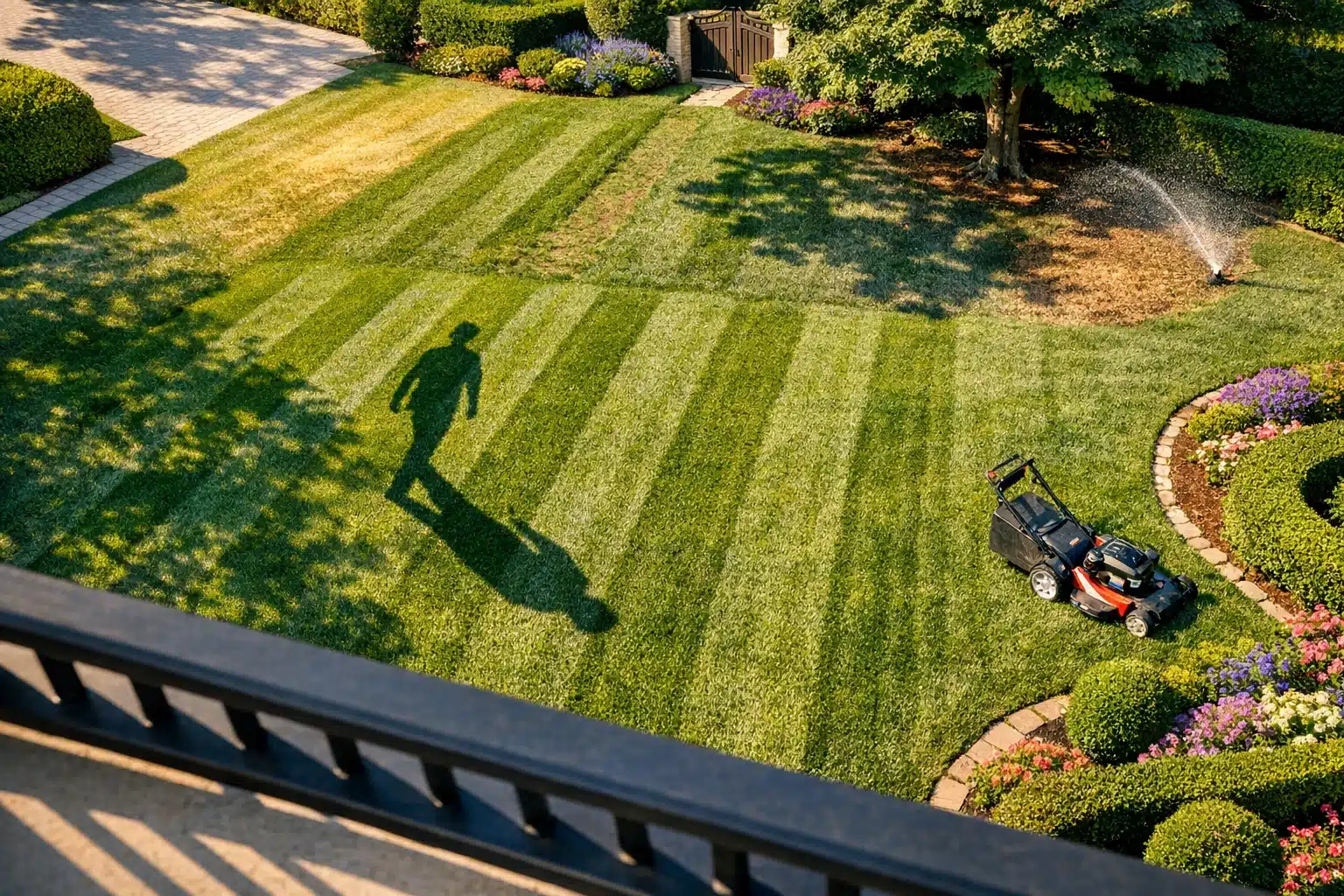
The title promises a simple 10-minute lawn care trick, and here it is: once a week, right after mowing or just before it, walk the entire lawn slowly and inspect it on purpose. That may sound almost too basic, but it works because most lawn damage becomes expensive only after it goes unnoticed. In ten focused minutes, you can catch early drought stress, mower scalp marks, fungal patterns, insect feeding, compacted paths, and emerging weeds before they spread. Think of it as a short conversation with the yard. The grass does not talk, of course, but it does leave clues everywhere.
This weekly check works best when paired with mowing high rather than too short. A common mistake is scalping the lawn because shorter grass seems like less work. In practice, grass cut too low loses leaf surface, shades the soil less effectively, dries faster, and gives weeds more sunlight to exploit. For many home lawns, keeping grass around 2.5 to 4 inches tall, depending on species, supports deeper roots and better stress tolerance. A good rule is to remove no more than one-third of the blade in a single mowing.
During your 10-minute walk, look for specific signals:
- Gray-blue color or folded blades, which can suggest drought stress.
- Ruts, thin lanes, or flattened areas caused by repeated foot traffic.
- Uneven cutting patterns that hint at dull mower blades or low mower settings.
- Small weed clusters that are easy to pull now but harder to control later.
- Debris, twigs, and dense leaf cover that trap moisture and block sunlight.
This habit is effective because it links observation with small action. You might raise the mower half an inch, move a play item that is smothering one spot, hand-pull a young broadleaf weed, or note that a sprinkler head is missing a dry corner. None of those tasks takes long by itself. Together, they prevent the slow drift from healthy lawn to tired lawn. There is also a psychological benefit: the yard stops feeling like a huge seasonal project and becomes a series of manageable adjustments. That is often the difference between a lawn that lurches from problem to problem and one that quietly improves month after month.
Watering, Feeding, and Timing: The Core Routine
If lawn care had a heartbeat, it would be timing. Water too often and roots stay shallow. Fertilize too heavily in the wrong season and growth becomes weak or stressed. Ignore seasonal changes and even decent products may underperform. A healthier yard usually comes from matching care to growth cycles rather than following a rigid Saturday routine all year long.
Watering is the clearest example. Most established lawns do better with deeper, less frequent watering than with a light daily sprinkle. As a broad rule, many lawns need about 1 to 1.5 inches of water per week from rain and irrigation combined, though climate, soil, and grass type can change the number. Sandy soil drains quickly and may need shorter, more frequent sessions. Clay holds moisture longer but can become compacted. The goal is to wet the root zone, then allow the surface to dry somewhat before the next watering. Morning is generally the best time, because it reduces evaporation compared with midday and lowers the chance of prolonged overnight leaf wetness.
Feeding the lawn also works better when it matches the grass you have. Cool-season lawns often benefit most from feeding in fall, when roots and shoots recover actively in milder weather. Warm-season lawns usually respond best when fully growing in late spring and summer. Soil testing helps here too. Fertilizer should solve a real need, not just satisfy the urge to “do something.” Overapplication can increase top growth without building durable roots, and it may contribute to runoff if applied carelessly.
- Use grass clippings when possible; they return some nutrients to the soil.
- Avoid fertilizing just before heavy rain, which can wash nutrients away.
- Adjust irrigation after rainfall rather than blindly following the timer.
- Watch shade separately, because shady turf often needs less water and slower growth management.
Seasonal timing adds another layer. Spring is often for cleanup, mower preparation, and modest feeding based on need. Summer is about stress management: higher mowing, careful watering, and avoiding aggressive renovation in heat. Fall is the prime repair window for many cool-season lawns, especially for aeration and overseeding. Winter, while quieter, is still useful for planning, soil testing, and staying off frozen or waterlogged turf. Lawn care becomes easier when you stop trying to force the lawn through the wrong season. Work with its calendar, and the yard usually rewards you with steadier color, thicker coverage, and fewer emergency fixes.
Weeds, Pests, and Bare Spots: Solve the Right Problem
A thin lawn rarely has just one cause. Weeds, insects, disease, compaction, drought, poor mowing habits, and low sunlight can all leave similar-looking damage behind. That is why the best lawn care approach is diagnostic rather than reactive. If you treat every brown patch like a fertilizer issue, or every weed outbreak like a chemical problem, you may spend money while the real cause keeps quietly spreading under the surface.
Start with weeds. They are often symptoms as much as they are nuisances. Crabgrass favors thin, open areas with plenty of sun at the soil surface. Broadleaf weeds such as dandelion or clover often move into sparse turf where competition is weak. In many cases, the most effective weed control is a thicker lawn created through better mowing, proper watering, and timely overseeding. Spot treatment can be useful, but it works best as part of a larger plan rather than as the whole strategy.
Pests are similar. Not every insect in the lawn is a threat, and not every damaged patch is caused by bugs. Grubs, chinch bugs, or sod webworms can damage turf in some regions, but confirmation matters. Lift a small section of turf, inspect the root zone, and look for patterns. Does the grass pull up easily? Are there visible larvae? Is the damage increasing in hot, sunny sections? Integrated pest management encourages this kind of observation before treatment, which is both practical and more responsible than broad, unnecessary applications.
- Pull or spot-treat young weeds before they seed heavily.
- Repair bare soil quickly, because empty space invites more weeds.
- Sharpen mower blades to reduce frayed tips that can make stress look worse.
- Aerate compacted areas where roots struggle to expand.
- Choose seed blends suited to the amount of sun and traffic in each area.
Bare spots deserve special attention because they are visual magnets; your eye finds them immediately. Yet repairing them is not hard when the cause is understood. Rake out dead material, loosen the top layer of soil, add quality seed for your region, keep the area evenly moist during establishment, and limit traffic until seedlings take hold. For warm-season lawns, plugs or sod may be more appropriate than seeding. A little compost can help improve seed-to-soil contact and moisture retention. The key is patience. A repaired patch rarely blends in overnight, but when the site conditions are corrected, it usually fills in far more successfully than repeated quick fixes ever could.
A Practical Conclusion for Busy Homeowners
For most readers, the real goal is not to become a turf specialist. It is to have a yard that looks inviting, feels good underfoot, and does not demand constant rescue. That is why the most useful lawn care plan is the one you can repeat. You do not need a shelf full of products or a calendar packed with chores. You need a few dependable habits, done at the right time, with enough observation to catch trouble early.
If you remember only the essentials, let them be these: know your soil and grass type, mow higher instead of shorter, water deeply rather than casually, feed according to season and need, and use that 10-minute weekly inspection as your early warning system. Those simple actions create the conditions that weeds dislike and healthy turf appreciates. They also make lawn care less emotional. Instead of reacting to every color change with panic, you begin to read the lawn with more confidence.
A realistic weekly and seasonal rhythm can be surprisingly straightforward:
- Each week: mow correctly, inspect the yard, remove debris, and note stress points.
- Each month: check irrigation coverage, sharpen awareness of traffic damage, and reassess problem zones.
- Each season: adjust watering, feeding, and repair work to match temperature and grass growth.
- Each year: consider soil testing, aeration where needed, and overseeding or patch repair in the proper window.
There is also value in perspective. A good lawn is not always the darkest green one on the block in every single month. It is often the lawn that recovers well, crowds out weeds naturally, and stays functional through weather swings and family use. Children running across it, pets circling familiar paths, chairs set out for a summer evening, shoes damp from morning dew: these are the small scenes that make a lawn matter. When care is consistent, the yard becomes less of a chore list and more of a usable outdoor room. For homeowners who want steady results without unnecessary complexity, that is the win worth aiming for.